Open Google Ads right now and look at your impressions, because they’re probably holding steady or even climbing. Now scroll to your click-through rate and that’s where the story changes. Budgets are running, ads are serving and somewhere between the impression and the click, a significant chunk of your traffic is vanishing before it ever reaches you.
The real problem goes deeper than a dipping CTR and understanding it properly is what separates teams that adapt from teams that keep optimising the wrong things.
AI Overviews Are Reshaping the Search Results Page
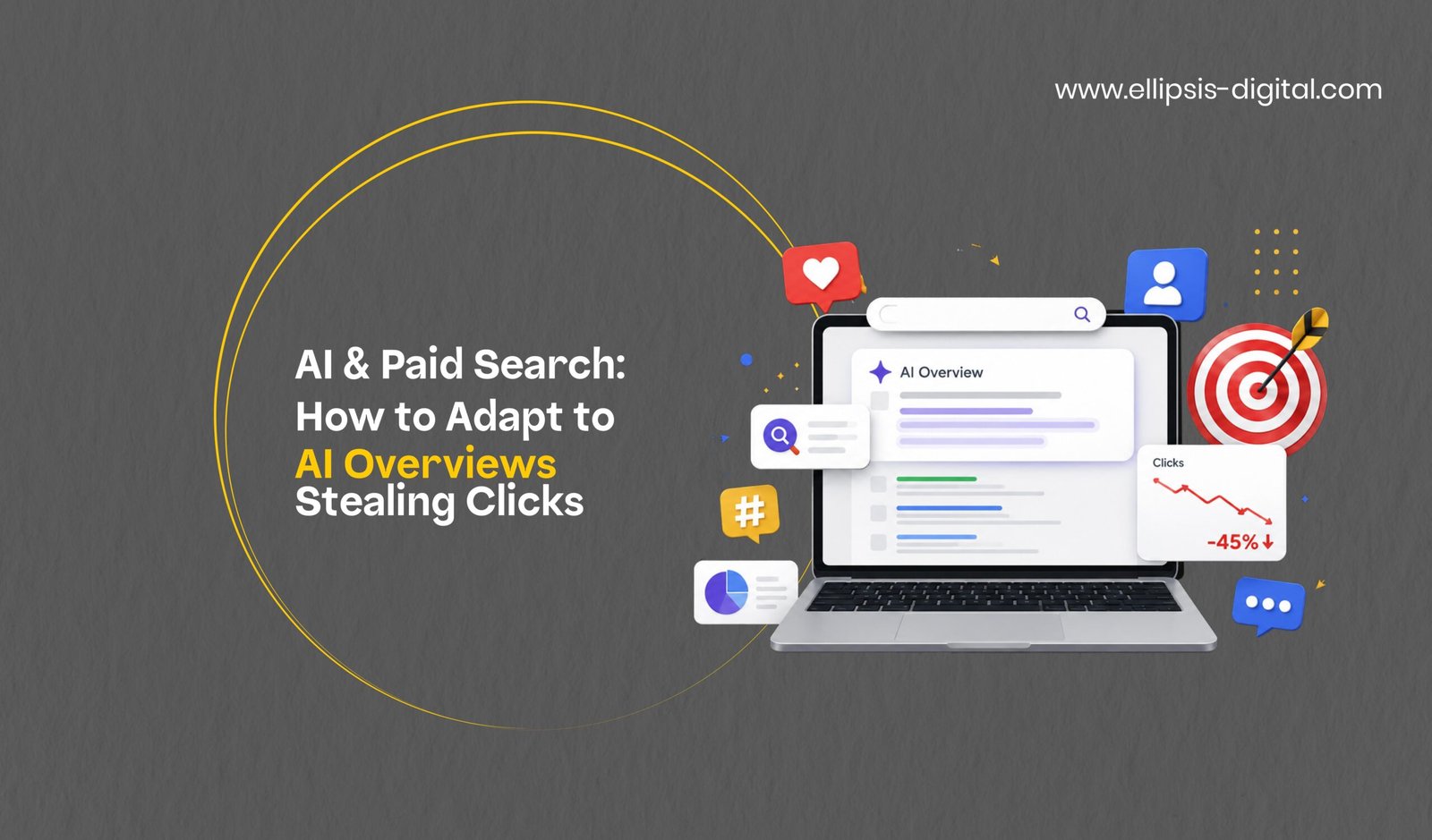
When Google introduced AI Overviews, it moved the AI-generated summary to the very top of the page, above ads, above organic results and above everything else.
By the time a user finishes reading it, their question is already answered. Your ad is sitting further down the page, waiting for an audience that has already moved on.
Your ads are still showing up. They’re just getting buried under an answer Google already gave.
Seer Interactive’s research found that paid click-through rate dropped from 21.27% to 9.87% on queries where an AI Overview appeared, which is a 53.6% reduction in traffic coming entirely from where the summary sits on the page rather than anything wrong with the ads themselves.
Impressions measure presence, clicks measure reality, and right now, only one of those is telling you the truth.
What makes this particularly damaging is the gap it creates between what your dashboard shows and what’s actually happening. Impressions still register when your ad loads so the account looks healthy on the surface, while the clicks you’re actually receiving quietly shrink in the background. Teams that miss this early end up making budget decisions based on data that’s pointing them in the wrong direction.
Why Informational Queries Are Becoming Less Valuable for Paid Search
AI Overviews appear most aggressively on informational queries, the searches where someone is trying to learn something rather than buy it. Searches like “how does retargeting work” or “what is a conversion rate”, or “best social media strategy for a small business” are precisely what these summaries were built for and Google now resolves them entirely within the page.
The research phase that once sent people through multiple pages of results now ends in a single AI-generated box at the top of the screen.
If a large portion of your keyword list sits in this territory, you’re paying for impressions that were never going to lead anywhere. The question worth asking about your own account is how much of your current spend is chasing clicks that Google is now answering for free.
Transactional searches are a different story entirely. Queries with genuine purchase intent like “CRM software pricing” or “book a digital marketing audit”, trigger AI Overviews far less often and when they do, ads still hold up well. Seer Interactive found that branded queries with AI Overviews still generated a 16.36% click-through rate, considerably higher than what informational terms were managing in the same environment. That gap is where the budget reallocation conversation needs to happen.
10 Paid Search Pivots Teams Are Making Right Now
The teams adapting fastest aren’t reinventing their entire approach. They’re making sharper decisions about where the clicks still exist and redirecting their energy accordingly. Here’s what’s actually changing across the industry.
1. Shifting budget toward high-intent searches
Spend is moving toward transactional and purchase-ready keywords: pricing pages, demo requests and comparison searches from buyers who already know what they want. Informational campaigns aren’t being scrapped entirely but they’re being pulled back and isolated, so they stop distorting account-level performance data.
2. Restructuring campaigns around intent stages
Grouping campaigns by intent stage rather than topic means that when AI Overviews start eating into a particular type of query, the response is clean and surgical. Informational, commercial and transactional keywords sitting in distinct buckets give teams the clarity to act quickly without disrupting what’s still working.
3. Protecting brand search more aggressively
A user searching for a brand by name has already moved past the research phase and their intent is about as high as it gets. Leaving those terms unprotected means competitors already bidding on your brand name can collect that traffic without much effort.
4. Rewriting ad copy for people who’ve already read the summary
A user who reaches your ad has often just read an AI-generated answer about the topic they searched. A copy that covers the same ground won’t earn a click from someone who is already informed and weighing their options. Something like “Get a free audit this week” or “See how our pricing works” speaks to where that user actually is in their decision.
5. Making ads visually stronger with extensions and assets
Ads appearing below an AI summary need to work considerably harder to earn attention and every available asset matters here. Sitelinks add navigation options, callouts reinforce value propositions, pricing extensions answer the buyer’s primary question before they click and structured snippets give product-level detail that a plain text ad simply can’t. A well-extended ad in that position will consistently outperform a barebones one sitting right next to it.
6. Going after competitor comparisons
AI Overviews regularly name specific products and brands when summarising a category and users frequently follow that up by searching “[competitor] alternatives” or “[competitor] vs [your brand]” almost immediately after. Bidding on those comparison queries means reaching people at the exact moment they’re actively choosing.
7. Making remarketing work harder
AI Overviews speed up the research phase but they rarely close a purchase on their own and most users still come back and search again before converting. First-party data from site visitors, email subscribers and CRM audiences gives teams the precision to stay visible across that return window in a way that broad keyword bidding simply can’t replicate.
8. Capturing conversational search queries
People who use AI tools regularly bring that conversational style to their searches and exact match keyword lists built around short traditional terms will miss a growing share of that traffic. Broader match types and Performance Max campaigns are being used more deliberately to capture these longer, less predictable queries as they become more common.
9. Expanding into YouTube and video
Search may be where decisions get made, but YouTube is increasingly where opinions get formed and for categories where AI Overviews are particularly aggressive, video is giving teams a way to reach users earlier in the journey before they ever open a search bar. Paid search and YouTube working together capture demand at both ends.
10. Aligning paid and SEO strategy
Informational content that once reliably drove organic traffic is now competing with AI Overviews from the organic side as well. A digital marketing agency managing both channels together has a real advantage in building a response that works across paid and SEO simultaneously rather than treating them as separate problems running on separate timelines.
Your PPC Dashboard Is Probably Lying to You
CTR alone no longer tells the truth.
A falling click-through rate in a search environment full of AI Overviews is often a reflection of how the page is structured rather than a sign that the campaign is underperforming. The costly mistake is treating it like a campaign failure and changing things that were never the problem.
Search Engine Land’s analysis confirmed that AI Overviews are pushing CTR down and CPCs up simultaneously, which means fewer clicks are available and each one costs more than before. Teams still measuring success primarily through CTR are concluding a metric that has fundamentally changed what it measures.
The measurement approach that’s actually holding up tracks several signals together.
- Impression share separates a visibility problem from an engagement problem and tells you whether your ads are actually showing up for the queries you’re targeting.
- Top-of-page rate matters more now because your position relative to the AI summary is directly tied to whether your ad gets seen at all.
- Branded search volume acts as a broader signal for whether your marketing is generating real demand over time, independent of what the SERP looks like on any given day.
- Assisted conversions show how search contributes to outcomes that close on a different channel or in a later session, which is increasingly how the buyer journey actually works.
SEMrush’s research found that AI Overview prevalence varies significantly across industries so how urgently this shift matters depends on your specific space, but most teams are running behind on it rather than ahead.
Search Doesn’t Start On Google Anymore
Google remains the dominant search platform but search as a behaviour has spread well beyond it. Users go to Reddit for product reviews, YouTube for how-to content, and tools like Perplexity or ChatGPT for research questions, with younger audiences regularly using social platforms as their first point of discovery before a Google search ever comes into the picture.
The search journey now starts somewhere else and ends on Google.
Paid budgets are following this shift and teams that once concentrated the majority of their digital spend inside Google Search are now running YouTube, Demand Gen, Performance Max, Reddit Ads and TikTok alongside it. The logic is straightforward: be present wherever demand is forming so that when someone eventually arrives at Google with real purchase intent, your brand is already part of their thinking. Search becomes the place you capture demand that was built everywhere else.
Key Takeaways
- Paid click-through rates are down more than 68% on queries with AI Overviews present, according to Seer Interactive, which makes impression share a more reliable account health signal than CTR on its own.
- Informational queries are taking the hardest hit, while transactional and high-intent searches are holding up considerably better and that gap is where the most important budget decisions need to happen.
- Ad copy that moves someone toward a decision outperforms copy that explains the category, because the AI summary has already done the explaining before the user reaches your ad.
- A measurement framework built around CTR alone will keep producing misleading conclusions until it expands to include impression share, top-of-page rate, branded search volume and assisted conversions.
- Search performs best now as part of a broader performance marketing strategy that builds demand across multiple surfaces and uses Google as the capture point rather than the starting point.
FAQs
Why are impressions going up while clicks are going down?
Your ad loads and registers an impression, but the AI summary at the top of the page answers the query before the user gets to where your ad sits, so the click simply never comes. Seer Interactive’s research found that this reduces paid click-through rate by more than 53% on affected queries and it’s one of the clearest signs that AI Overviews are actively affecting your account.
Are all searches affected equally?
They’re not and this is the most practically important thing to understand right now. Informational and research-stage queries are hit the hardest because AI Overviews were built precisely to answer them, while transactional searches with genuine purchase intent trigger AI Overviews far less often and still deliver strong ad engagement when they do.
Does this mean paid search is losing its value?
High-intent and brand campaigns are still converting well and the channel remains valuable where it’s being used correctly. The issue sits specifically in informational keyword spend that has become considerably softer and a proper intent-based audit of your campaigns will show you exactly where the problem is concentrated.
How does this affect SEO strategy?
Organic informational content is facing the same AI Overview pressure from the other side and the teams that build a coordinated paid and SEO response together will move faster and further than those treating them as two completely separate challenges.
Conclusion
The brands reallocating toward intent, reading their data honestly and expanding their channel mix are pulling ahead and the gap between those two groups is only going to widen as AI Overviews become more embedded in how search works.
Ellipsis Digital builds paid search and performance marketing strategies for exactly this kind of environment. If you want a clearer picture of where your current strategy is leaking and what to do about it, start here.