
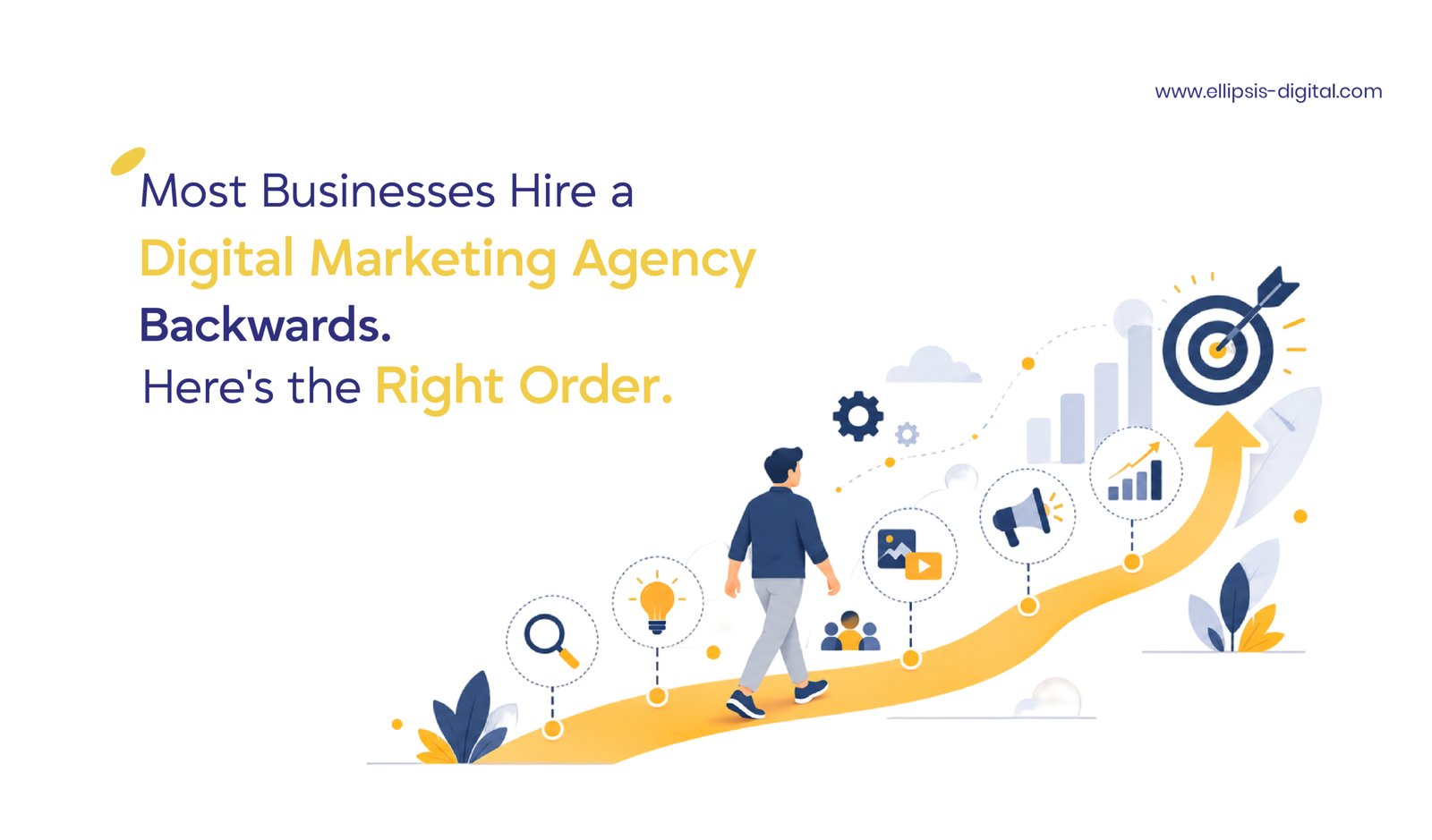
Say you run a two-year-old skincare brand out of Baner. Sales come mostly from Instagram DMs and a WhatsApp broadcast list your cousin set up during the pandemic. Someone tells you it’s time to get serious about marketing, so you Google “digital marketing agency” and within the hour you have eleven tabs open. Three of them promise guaranteed leads. Almost none of them explain what they’ll actually do with your money, or how you’ll know if it worked.
Most businesses in this spot get the sequence wrong. They ask about the price before they’ve written down what they need. They pick whoever pitched the best deck. They only start thinking about how to measure results once the first invoice has already landed, and by then there’s not much to hold anyone to.
A recent survey of over 3,000 MSMEs by Google and the India SME Forum found that only 13% currently use digital marketing tools in any structured way, even though the same businesses are perfectly comfortable with UPI and online listings. So this isn’t really about awareness anymore. It’s just that nobody’s laid out the order these decisions should happen in.
Table of Contents
- Choosing the right agency
- Writing an RFP that actually gets you answers
- Retainer or project: how the pricing actually works
- Figuring out what ROI should even mean here
- Key Takeaways
- FAQs
- Conclusion
Choosing the right agency
Everyone starts by looking at portfolios and follower counts, which is a strange way to judge a business that’s supposed to grow yours. A better question: has this agency actually solved your specific kind of problem before?
A restaurant chain trying to fill weeknight tables needs someone who lives and breathes local search and Google Business Profile, the kind of hyperlocal content that gets a person to actually walk in. A B2B manufacturer selling machine parts across three states needs LinkedIn-led demand generation and patience for a six-month sales cycle. Those are two different jobs. An agency can be brilliant at one and mediocre at the other and “full-service” on a website doesn’t tell you which.
Ask who’s actually doing the work, too. A common setup at smaller agencies: a senior person runs the pitch, then a junior team quietly takes over execution with a lot less oversight than the meeting implied. That’s not automatically a problem. Junior teams do great work all the time when someone’s actually managing them. But you want to know this before signing, not three months in when your point of contact has changed twice.
And ask to see a real monthly report before you commit to anything, an actual one, not a mock-up. If it’s just impressions and reach dressed up nicely, that tells you what your reporting will look like once things settle into routine.
Writing an RFP that actually gets you answers
RFP sounds like something only large companies bother with, all procurement departments and thirty-page documents. For a small business it can be a page, maybe two. What it’s really for is getting every agency to respond to the same question, so you’re comparing actual proposals instead of comparing how good each salesperson was on the call.
Cover five things. Where your business stands today, including “we’re doing nothing structured yet” if that’s the truth. The actual problem, stated as a problem, not a wish. “We get enquiries, but our close rate is low” gives someone something to work with. “Improve our digital presence” doesn’t. A rough budget, so agencies aren’t guessing and quietly ruling themselves out later for guessing wrong. Your timeline. And how you’ll judge what comes back.
Send that same page to three or four agencies. What comes back matters less than how it comes back. The questions they ask you, how specific their approach sounds, whether they push back on anything. If a vague brief gets you a vague proposal, pay attention. You’ll probably get the same level of clarity once the actual work starts.
Retainer or project: how the pricing actually works
Once quotes start rolling in, the numbers can look all over the place. Underneath the confusion, there are really only two models worth understanding.
A retainer is a fixed monthly fee for ongoing work, usually SEO, social, or content, the kind of thing that builds up over months rather than delivering a single payoff. Project pricing is a flat fee for one defined thing with an end date, a website rebuild, say, or a single campaign. One 2026 pricing breakdown for the Indian market puts retainers at roughly 70% of ongoing agency relationships now, because channels like SEO simply don’t reward a quick burst of effort and then stopping.
On actual numbers, expect a wide range depending on how much you’re asking for. A focused, single-channel retainer, say just local SEO or just social management, tends to sit somewhere between ₹25,000 and ₹1,00,000 a month for a small business. Bundle in three or four channels together, add strategy and reporting on top, and that same relationship can climb toward ₹2,50,000. The scope is what moves the number, not the agency being expensive or cheap.
Which model is right depends on what you’re actually buying. Something that compounds, an audience, search rankings, a library of content that keeps pulling traffic, suits a retainer, because it aligns what the agency gets paid with what you’re trying to build long term. A one-off deliverable suits a project fee. Watch out for agencies pitching a short “growth project” that’s really promising compounding results without the retainer to back it. That’s project pricing wearing a retainer’s clothes.
Honestly, the number on the quote tells you less than the scope document behind it. Two agencies can quote nearly the same monthly fee and mean completely different things by it: one covering ad spend inside that number, the other billing it separately; one giving you two revision rounds, the other giving you unlimited. Read the scope line by line before comparing prices.
Figuring out what ROI should even mean here
This is usually the last thing anyone thinks about, which is backwards, because it’s the one thing worth nailing down before you sign, not after the first monthly report shows up and nobody’s quite sure what they’re looking at.
Even sophisticated companies with full analytics teams struggle here, for what it’s worth. The CMO Survey, run by Duke University’s Fuqua School of Business with Deloitte and the American Marketing Association, found in its 2026 edition that companies rate themselves well at picking the right marketing vendors, 4.9 out of 7, but noticeably worse at demonstrating ROI from that spend, 4.4. Big companies with dedicated data teams can’t always draw a clean line from marketing spend to revenue.
A small business shouldn’t feel bad about finding this hard either. The same research found companies now outsource around a third of their digital marketing to outside partners, so hiring an agency really isn’t some unusual leap anymore.
What actually helps is agreeing, in writing, on which specific numbers matter for your business before the campaign even starts. A lead-gen business should care about cost per qualified lead and close rate, not raw lead count, which is trivially easy to inflate with junk traffic. A retail or D2C brand should watch customer acquisition cost against actual order value, not impressions, which look great in a slide and mean almost nothing on their own. A service business built on repeat clients should track retention and referrals over six months, because a single month rarely tells you the real story.
Give it time, too. Search work especially takes three to six months to settle into something readable. And ask, before signing, how the agency plans to separate their own impact from everything else happening in your business at the same time. A festival season spike or a competitor’s bad quarter can move your numbers without the agency doing anything at all.
Key Takeaways
- Only 13% of Indian MSMEs currently use digital marketing tools in a structured way, so getting this hiring decision right puts you ahead of most of the market, not just competing in it.
- Pick an agency whose actual experience matches your kind of problem, not the one with the shiniest portfolio.
- A short, specific RFP sent to three or four agencies gets you comparable answers. A vague one gets you vague proposals back, which tells you something too.
- Retainers suit ongoing work that compounds, project fees suit one-off deliverables, and the scope document matters more than the number on the quote.
- Agree on specific, business-relevant metrics before you sign, and give the work three to six months before concluding.
- Even large companies with full analytics teams find it hard to prove marketing ROI cleanly, so build the relationship around agreed metrics rather than one tidy number.
FAQs
How much should a small business in India realistically budget for a digital marketing agency?
For one focused channel, think ₹25,000 to ₹1,00,000 a month. Add more channels or a bigger strategy layer and it climbs toward ₹2,50,000. Treat any published range as a starting point for a conversation, since the real number depends entirely on what’s inside the scope.
Is it better to hire a local Pune-based agency or a larger national one?
Depends on where your customers actually are. A local agency usually understands hyperlocal search and the city’s competitive landscape better, which matters a lot if you rely on foot traffic. A bigger agency can bring more specialised talent for complex, multi-market work.
What’s the actual difference between an RFP and just asking a few agencies for quotes? A quote request gets you a price. An RFP gets every agency responding to the same specific problem, which makes the proposals genuinely comparable and shows you how each one actually thinks before you’ve committed to anything.
Should I sign with an agency that won’t commit to specific KPIs before starting?
Be cautious there. A good agency will discuss and agree on metrics tied to your business, even while being upfront that some numbers, like exact lead volume in month one, can’t be guaranteed. If they avoid the conversation entirely, that’s worth pushing on.
How soon should I expect to see results?
Depends on the channel. Paid ads can show early signals within weeks. SEO and other search-driven work usually needs three to six months before the data means anything. Anyone promising fast, dramatic SEO wins in the first few weeks is setting you up for a letdown the channel itself can’t deliver.
What’s a red flag during the selection process?
Vagueness, mostly. Ask what a monthly report looks like, who’s actually doing the work and how they’ll separate their impact from everything else going on in your business. If the answers stay general and reassuring instead of concrete, that vagueness usually shows up again later.
Conclusion
There’s no such thing as the perfect agency, so that’s not really the goal here. The goal is deciding in an order that protects you: know your own problem well enough to write it down, get comparable answers from more than one place, understand what you’re actually paying for, and agree on what success looks like before the relationship starts rather than arguing about it three months in.
Ellipsis Digital, a creative and digital marketing agency in Pune, is built around exactly this kind of upfront clarity, matching the right channel strategy to the shape of a business’s actual problem instead of selling the same package to everyone who walks through the door. If you’re working through this decision yourself and want a second opinion on your brief before it goes out, that’s a conversation worth having.