
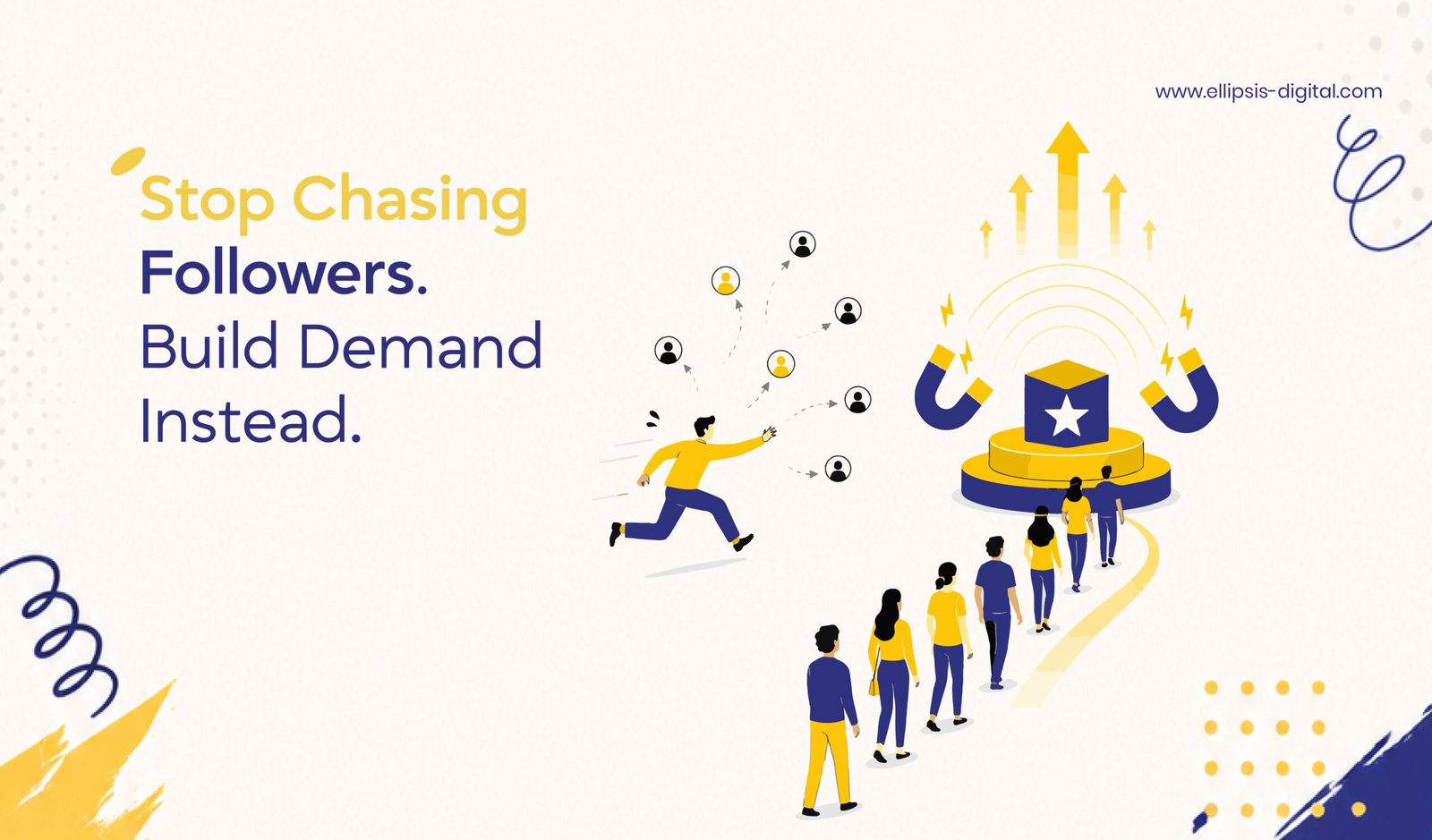
Walk into most marketing review meetings and you’ll find a slide everyone is proud of. Follower growth, quarter on quarter, going up and to the right. Instagram tripled. LinkedIn doubled. The graph looks great.
Then someone asks the obvious question. How many of those followers actually bought something, referred someone, or even replied to a DM? Most teams don’t have an answer, because nobody was ever asked to track it. Nobody wanted to admit the number they’d been celebrating for a year didn’t actually mean anything.
Followers Don’t Buy. Intent Does.
A follower isn’t ‘demand.’ It’s evidence that someone once found you interesting enough not to hit “unfollow.” Those aren’t remotely the same thing and treating them as interchangeable is how a growing account and a flat pipeline end up sitting in the same quarterly report without anyone noticing the contradiction.
Demand is different. Demand is when someone already has a problem in mind and your name shows up unprompted when they start looking for a solution. Nobody had to chase them.
Gartner’s research into B2B buying behaviour puts a number on how much of this happens before a brand ever gets a say in it. A survey of 646 B2B buyers found that 45% reported using AI during a recent purchase and separately, 67% now prefer a rep-free buying experience entirely. Source: Gartner Newsroom, 2026.
Most of the decision is already made by the time anyone on your team hears about it. A visibility strategy built entirely around a follower count on a public feed is optimising for the one part of the journey that increasingly decides nothing.
Demand Isn’t a Bigger Funnel. It’s a Head Start.
People treat demand generation and lead generation as the same thing wearing different clothes, and that mix-up costs a real budget. Lead generation asks for something. A form fill, an email address, a demo booking, usually in exchange for a gated PDF nobody particularly wanted to read.
Demand generation flips who moves first. You put something useful or well-argued out into the world with no gate and no immediate ask, and people form an opinion about your brand before a salesperson ever enters the picture. By the time they do reach out, you’re not being evaluated. That decision got made in a browser tab weeks earlier.
Here’s the uncomfortable part. Demand generation is slower to show up in a weekly report and a lead gen campaign gives you a number by Friday. Demand shows up as a shorter sales cycle two months later, or a prospect who opens with “I’ve been following your stuff for a while.” Neither of those fits neatly on a dashboard, which is exactly why teams keep defaulting back to lead gen even after admitting it’s the weaker long-term bet.
Your Biggest Marketing Channel Doesn’t Have a Feed
Here’s something worth sitting with. Most of the sharing that actually moves someone toward a purchase never happens on a platform you can measure. Mailchimp’s own research on this is blunt about it: up to 95% of what shows up as “direct” website traffic actually comes from dark social, meaning links dropped in a WhatsApp group, forwarded over email, or pasted into a Slack thread by someone who has never once seen your marketing calendar.
That traffic lands in your analytics with no indication of where it came from. A colleague forwarded your blog post internally. A friend recommended your product in a private group chat. None of it shows up as a like or a follow, and all of it sits closer to the actual moment someone decides to trust you than any public comment section ever will.
Which means the account that looks quiet on the surface might be doing more work than the one racking up likes, and the account with the busiest comment section might be convincing nobody outside of it.
Trust Is Earned Long Before Anyone Asks for a Demo
Ask someone what actually convinced them to try a new product and it’s rarely an advertisement. Nielsen’s global research has held remarkably steady on this for years: 88% of respondents trust recommendations from people they know more than any other channel. Source:
Reach can be rented. A media budget buys impressions on demand. Trust can’t be rented the same way, which is exactly why a brand with two hundred thousand followers and a comment section full of emojis can still lose to a competitor that twelve people keep recommending to each other unprompted.
This is also why influencer deals built purely on follower count keep underdelivering. The audience isn’t hearing a recommendation. They’re hearing an ad, read aloud by someone who happened to be large enough to be worth paying. The version that actually moves people only works when the person talking has a real relationship with their audience, not just a wide one.
What Building Demand Actually Looks Like
None of this is abstract. It shows up in specific, occasionally uncomfortable choices.
It looks like publishing something with an actual point of view instead of something safely neutral, since neutral content gives nobody a reason to repeat it to a colleague. It looks like letting founders and team members show up as people with opinions rather than hiding every statement behind a brand account with no personality, because people share people, not logos.
It also looks like being specific about who you’re for, and just as importantly, who you’re not for. Vague positioning gets forgotten by lunchtime. Specific positioning gets repeated, because it hands people language to describe you to someone else without having to think too hard.
And it takes longer than most teams are comfortable with. Educating an audience on something they didn’t know they cared about takes months of consistent, useful content before it turns into anything measurable, which is exactly the stretch where most teams quietly give up, usually a few weeks before the compounding was about to start.
You’re Measuring the Wrong End of the Funnel
If follower count isn’t the scoreboard, something else has to replace it, and the honest answer is that it takes more than one number to do the job properly.
Branded search volume is one of the more reliable signals, since it tells you whether people are actively looking for your name rather than stumbling across it by accident. A rising trend in unattributed “direct” traffic to deeper content is often a sign that dark social sharing is doing work you can’t trace directly but can still infer from the pattern. Sales cycle length shortening over time, with no change in pricing or discounting, usually means prospects are arriving already halfway convinced. And inbound conversations that reference a specific piece of content or a specific position you’ve taken tell you far more than a follower graph ever could.
None of these fit neatly into one slide the way a follower count does. That’s precisely why most teams keep avoiding them. They’re also the only numbers that actually explain whether the business is growing or whether the account just looks busy.
Key Takeaways
- A follower is a one-time decision from the past. Demand is someone actively looking for you today.
- Demand generation changes who moves first, letting the buyer arrive already convinced instead of being persuaded on the spot.
- Most B2B buyers are deep into their own research before a salesperson enters the picture, per Gartner’s 2026 findings.
- Most of the sharing that influences a purchase happens in private channels no analytics dashboard can see.
- Reach can be bought. Trust has to be earned, which is why personal recommendation still outperforms every paid channel.
- Track branded search, sales cycle length and inbound conversation quality instead of follower growth if you want an honest read on demand.
FAQs
If followers don’t matter, should we stop posting on social media altogether?
No, but the goal of what you post needs to change. Post to build a point of view people remember and repeat, not to inflate a number with no clear link to revenue.
How long before demand generation shows measurable results?
Most brands see a real shift somewhere between four and six months in, and it depends heavily on how consistent and specific the content has been. It rarely happens on a campaign timeline of a few weeks.
Our follower count is actually growing. Isn’t that a good sign regardless?
Depends entirely on why. Organic growth tied to content people are sharing with intent is a good sign. Growth from a giveaway or a follow-for-follow push usually isn’t, since none of those people came looking for you in the first place.
How do we track something as invisible as dark social sharing?
You can’t measure it directly, but you can watch for its fingerprints: a rise in unattributed direct traffic to deep content, an uptick in branded search, and prospects mentioning specific things they read before ever contacting you.
Does this mean influencer marketing is a waste of money?
Not at all, but selection matters more than budget. A smaller creator with a genuine, specific relationship with their audience will usually move more people to action than a larger one with a broad but shallow following.
Conclusion
None of this argues against being on social media. It argues against mistaking a number that’s easy to screenshot for one that actually predicts revenue. A follower count tells you how many people once clicked a button. Demand tells you how many people are already looking for what you sell before you’ve said a word to them. Only one of those is worth building a strategy around.
Getting there means giving up the easy scoreboard and tracking the harder, slower signals instead: branded search, sales cycle length, the quality of what people say when they finally reach out. That’s precisely the kind of shift Ellipsis Digital, a creative and digital marketing agency based in Pune, is built to help brands think through, starting with what a business actually stands for before a single post gets scheduled.